When Cristina Sussman-Marcos was 2 years old, her family moved from the Spanish island of Mallorca to Missouri for her mother’s teaching position at a local university. Despite growing up in the American heartland and having family roots in Toledo, Cristina says the culture she was raised in was Mallorcan. She knew her family was Jewish, but they weren’t observant and much of the culture she knew was Catholic — she celebrated her Name Day every year, the day of the saint she’s named after, Saint Christina.
The first Jewish families arrived on the island as early as the 2nd century (some sources point to later dates). But in the early 15th century, they were forced to convert to Catholicism — decades before the Spanish Inquisition of 1492. Jews who converted and remained on the island were known as xuetes, which comes from xueu, the local word for Jew, but may also descend from the word for lard since those who converted were forced to eat pork to prove they had abandoned Judaism.
In Mallorca, there are 13 (some sources say 15) last names that distinguish historically Jewish families, but some who practice religious traditions, do so quietly. “It was very odd to move to the States and have Jewish friends that were very openly Jewish — that was very different from how I grew up,” Cristina explains. For her, being Jewish was about the music her family listened to and dishes they ate.
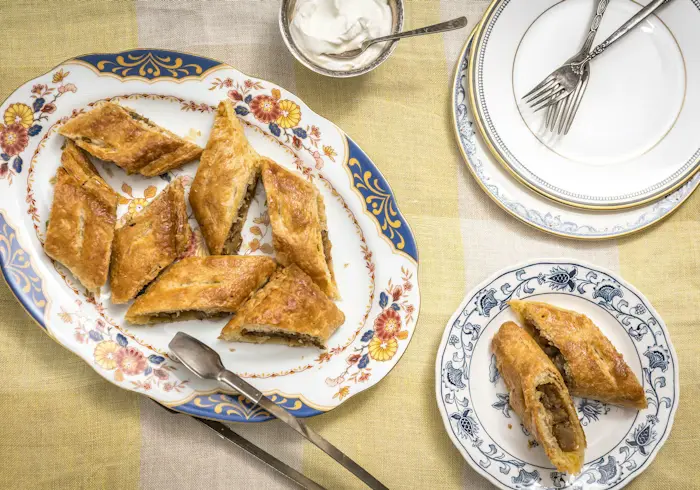
Passovers in Missouri were spent watching “The Prince of Egypt” and eating panades, savory Mallorcan hand pies in the shape of small lidded pots. “Mallorcan Jews created this iconic look for their panades as a Shabbat food, where they could be popped into the oven before sundown on Friday until the next day,” Cristina explains. Despite being made with flour, they became a tradition for Passover. (Renditions made with lard are also an Easter specialty on the island.)
When Cristina’s family moved back to Mallorca when she was a teenager, she started to explore her Jewish heritage more deeply. Knowing that her name has a strong connection to Christianity, she sought out a database of names from the period of Al-Andalus and adopted Astera as a second name for herself. She learned Ladino and began writing poetry and a children’s book in the language. “I'm working really hard to keep that alive,” she says.
Cooking notes: “The fillings for panades change depending on one’s liking, the holiday that’s just around the corner, the time of the year, and even the different towns across the island,” Cristina explains. In her family, they typically make the dough with milk. We’ve tested and published the recipe with water so it can be made kosher.
This recipe comes from “Tlaim: The Patchwork Cookbook,” a grassroots project dedicated to celebrating the ethnic and racial diversity of the Jewish community. With over 70 delicious recipes and stories, Tlaim centers underrepresented Jewish identities such as Jews of color. Follow Tlaim on Instagram and sign up to be notified of the release of the cookbook, which is made in collaboration with non-profit Be’chol Lashon. Explore more recipes from Tlaim here.